Showing posts with label Understanding Context. Show all posts

Monday, 20 February 2017

Art Nouveau

Art Nouveau = New Art in French

It is a style that is based on stylised plant forms and it is really very decorative.

The Art story website has some information on it that it would be useful to look at, as does artsy.net

In completing your Art nouveau research page it should have the following:


  • Some drawing of Art Nouveau (does not have to be a complete pattern, but should be very detailed in what you do present and good quality)
  • another drawing of a new leaf/plant form on the other side of the page
  • 6 - 8 facts about Art nouveau that you peer check (try to stick to the sites I have given you)
  • Colour used appropriately
  • No off-task drawings on your work or in your books
There is this particular form that is the building block of Art Nouveau - It is called a 'whiplash'.

Make sure you identify this form in your Art nouveau drawing and can recognise it easily.

I will be MARKING these two sheets of research specifically for feedback for your first set of reports. 


Wednesday, 15 February 2017

Year 11 in 2017

What we are doing:

You need to start with your concept; by now you all should have 3 words added to the google tracking sheet we have shared with you. Those three words should help express a direction for the meaning behind your work.

You should all have a couple of Artist models that your teacher has directed you to look at. Many of you will have started some drawing around this too.

You should all know where the research document is located on the google site and be working through it with one image from one artist.

If that is getting hard and confusing consider first - if you do this three or four times with a compare contrast at the end of they year, we can in fact make sure it counts for research credits (1.1) with a few tweaks. Second - I will upload an exemplar of what it could look like so that you are a little less confused.


Sunday, 13 November 2016

Work for Monday - start with the form, no longer than five minutes please - it is easy

Hello class, today I was not planning to be away. Never mind

I suspect there will be half a dozen of you who cannot 'fond' your google drawing file from last time - open your google drive and go to 'recent' is probably the easiest way to find it. It WILL be there.


When you have finished this form, your teacher will go through the instructions for the lesson. Listen and pay attention, I have expectations for Wednesday!

Learning outcome:
The role of the artist in telling a story (using narrative approach)

Should already have:
- Your brainstorm branch at the top of a page
-Your google draw file open in front of you - FINISHED - 6 images relevant to your brainstorm on it.

Tasks: - we are designing a series of ideas for a painting based on the narrative. 
Must do:

  • The form above and getting your thumbnails sketches out.
  • Observational drawing from one or two of your google images that you have collected
  • Plan at least three ideas where you show you are thinking about 'story' or 'narrative'
Could do:
  • Make a clear effort to use Manga styles in your work (eyes, comic layout, speech bubbles etc)
  • Make a clear effort to use Pasifika patterns in your work
By the end of the lesson:
  • Google form is done, I will bug you if it isn't
  • Google drawing with research images (photographic ones) are sorted
  • Thumbnail sketches page has brainstorm branch on it, observational drawing on it and thumbnail sketches that could become your final painting on it. 

Good luck.

Please share your work on your school blog if you like so I can see. I will show you how to use it properly on Wednesday if no one else has yet.


Tuesday, 8 November 2016

Defining your narrative

If you missed this lesson, we watched this as a starter.

what did we learn about why Feu'u makes his work?
- culture
- life
- death
- experiences
- meaning

Everything had a meaning or a reason behind it.

The task was to create a brainstorm on a topic of your own choosing. Absolutely anything. At least 5 words should have branched off your main brainstorm word:

 this is my example one on the board on Mickey Mouse. Five things that instantly came to mind.

Choose at least one of these things to extend your ideas:

 I chose 'Minnie' and then from there it was 'heels', 'female', and 'cutesy' that came to mind.

If I was using this as an overall concept, it is the male and female roles Disney portrays. Everyone should have been to this point by the end of the lesson. Everyone will have a different concept.


Wednesday, 2 November 2016

Posting a decent blog post

Today in 8GB and 7 BK we worked on reforming our blog posts using a bit of structure.

Here is how it goes:

1) Open up your Google Draw on Street art and make sure it is downloaded as...JPEG.
2) Open up www.blogger.com and make sure you can see your school blog - is should read [your name] @ Hornby High School. If you cannot see that, email me and I will let admin know.
3) Make a new post (or edit the one you already made).

4) Use this template to make sure you are writing a blog post with some quality.
1) Your Learning Outcome is:
The role of the Artist as an antagonist - Year 8
The role of the Artist in disrupting what is 'accepted' - Year 7

In Year 8 you need to show you understand that word Antagonist. It would be useful if you understand the word Protagonist too, as it is the opposite role. You can use google to do this bit, but put it your own words.

2) Learning process - describe what you did to make your JPEG. As little or as much detail as you want here.

3) Evidence - You have already done this - it is your JPEG. You need to upload it to your blog. Below is a screen shot. See the blue word that says LINK? There is a little landscape image next to it. THAT is the button you use to insert an image. 


4) What worked, what didn't, what to change - this can be a list. NEXT re-state your learning outcome and try and write a sentence that reflects what you think you understand of it now. 

This is homework for anyone who didn't complete this in class. Due by the time I see you in class next Thursday.

Wednesday, 12 October 2016

Street art and stencilling your ideas


We are staring with you developing your own research document on Google Draw.


The things you need on your drawing are:

1) Two attributed images of Banksy's work
2) One piece of work by an Artist called Shepard Fairey - attributed
3) 4 facts about what street art is
5) A youtube link to how to make stencils for spray painting.
6) A title of your own design.

Once your google drawing is complete, you need to share it with me and post it on your blog. to do this, download as... "PDF" or "JPEG" and insert it into a post. Make sure you use a label for Art. I will help you with this bit if it is confusing.


Wednesday, 3 August 2016

Picasso the Rebel

We talked last week about how Picasso should take a great deal of credit for you being allowed to be openly creative as art makers today.

He was a rebel, he became an art revolution.

You will have a slide presentation for your work shared with you in your google drive. If you don't (newer class members) ask a friend to share theirs with you and "make a copy" of it for yourself.

This is the theory base for the term. Please complete your research page with 6 facts about Picasso and some drawing work from one of his paintings.

The link between photography and painting may not seem very clear just now, but it is important and we will explore it more later


This example comes from Caleb in 8mt of a pretty good looking research page.  Aim for this level of quality.

Tuesday, 7 June 2016

Developing Ideas for making your own Munch inspired print

Outline of what we did today:

We need to get something to make an art based image from, using mono-printing, that has some meaning to you.

We opened two tabs; Google images search and pixlr.com.
Searching for images under labelled for reuse is very important. It means you aren't stealing an image and you are showing respect.


- Why is it important to use work labelled for re-use?
- Who did you choose and why?


When you open www.pixlr.com, you will get a screen that gives you some options to download files. Sign up to pixlr using your school email and password so you don't forget them.

1) Web-based apps
2) Pixlr editor (not express)
3) Play and experiment with the image to change the colours, warp the form and stylise it. You should be thinking along the lines of Edvard Munch and his forms he uses.


Making marks from your selfie

Unity - Kotahitanga

Putting your progress so far together as a potential art work; 
  • term two selfie, how can you incorporate this, 
  • term two understanding of German Expressionism and woodcut technique, how can you best use this, 
  • as well as your own personal expression? 


It is really important that you process your selfie as a graphic, black and white drawing that focusses on translating tone into MARK MAKING and texture, not shading. That might mean you interpret some areas a little differently to how they appear, or that you change tones into marks, or simplify them. It might mean you try one way of doing things and it does not work. That means try another way. Don't just quit. You also should be focussing on making this drawing NOT pretty. It is meant to be you considering how over-the-top and self-obsessed the idea of the selfie is. Make it ugly, make it creepy, make it a bit angsty, but let's not glorify it. 


From here, you should be moving onto our Pinterest site for German Expressionism and beginning some thumbnail sketches. We can go over how to manage these more carefully in class. 

Tuesday, 24 May 2016

German Expressionism

By now we all should have seen this. It is here fi you want to go through it again, or you have deleted/lost the email link I sent you...

The research pages are looking really good and we are working towards some printmaking with mono-prints and possibly drypoint etching :-)

Thursday, 25 February 2016

Impressionism - Revolutionaries

Impressionism is from the19th-century. It is an art movement. This means there were a group of Artists who had similar ideas and became known for a particular style and/or way of thinking in their work.

It started during the 1870s and 1880s. Remember what was invented just before this time? We discussed it in class.

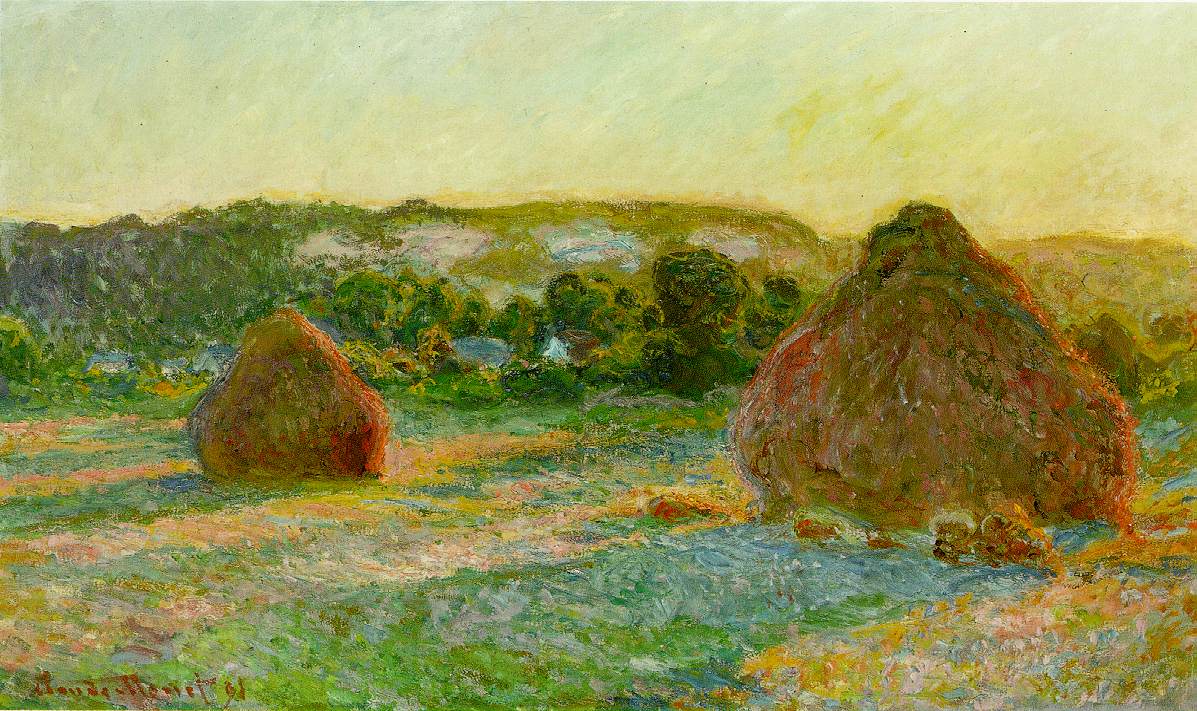
Impressionist paintings all have really visible brush strokes, they often show light and its changing qualities (think about the Haystacks by Claude Monet I keep showing you all and how you can see when it is a different time of the day), ordinary subject matter, trying to show movement in the works and using new angles in painting that had not been used before.


Wheatstacks_(End_of_Summer),_1890-91_(190_Kb);_Oil_on_canvas,_60_x_100_cm_(23_5-8_x_39_3-8_in),_The_Art_Institute_of_Chicago.jpg
Claude_Monet._Haystack._End_of_the_Summer._Morning._1891._Oil_on_canvas._Louvre,_Paris,_France.jpg
Claude Monet, 1890-91 Oil on canvas, 60 cm × 100 cm (23 5⁄8 in × 39 3⁄8 in). Location currently: Art Institute of Chicago “Wheatstacks; end of summer”
Claude Monet, 1890-91 Oil on canvas, 60.5 × 100.8 cm (23.8 × 39.7 in). Location currently:Louvre, Paris, France “Wheatstacks; end of summer” (again, he did a lot of these).


Remember your HOMEWORK: notice the sunset. Pick an object to watch outside your bedroom window and notice how the light/colour/look changes as the light fades.

The Académie des Beaux-Arts controlled everything about French art. The Salon (a panel of experts) selected the works considered suitable for the Académie each time they had an exhibition.

After Emperor Napoleon III (France's leader) saw the rejected works of 1863, he decided that people could look for themselves at how useless the Artists were who had been rejected. He wanted the people to come along and laugh at them.

This was called the Salon des Refusés (Salon of the Refused). This actually backfired. People did come, more than usually attended the actual Salon, and quite a few liked what they saw. It was not the same old boring stuff they were used to seeing and showed things that were happening in people's everyday lives at the time.

In December 1873, Monet, Renoir, Pissarro, Sisley, Cézanne, Berthe Morisot, Edgar Degas and several other artists founded the Société Anonyme Coopérative des Artistes Peintres, Sculpteurs, Graveurs ("Cooperative and Anonymous Association of Painters, Sculptors, and Engravers") to exhibit their artworks independently.[9] ( this bit is from https://en.wikipedia.org/wiki/Impressionism and those links will take you to those Artist’s wikipedia pages)