Showing posts with label Year 10. Show all posts

Saturday, 8 June 2019

Year 10 progress on double page spreads (DPS)

Kia ora koutou

I have updated the site with another screencastify of good and bad DPS, and hopefully, you all have a handle on clipping masks and using the opaque/transparency function.

A couple of things I covered with individual groups during the lesson were:

themes; what is your basic theme? does your design represent it? Te puna auaha - spring of creativity. can I see anything that visually represents this? if not, what can you do about that? Does your font relate to your topic you are writing about? And with Molly, Natasha and co, what can you take from Wassily Kandinsky and Tchaikovsky to your work?  That was a big leap by the way.

For any of you who are interested in going off on a tangent; Kandinsky had synaesthesia. It means he would hear stuff and then see shapes and colours in response to what he heard. It is very rare.

Kandinsky, who was from Russia, loved art and music.


Tchaikovsky was a highly passionate composer of classical music and he was also from Russia:


The richness of the layers in the music lends itself well to how a synaesthetic artist could work. 

A modern day version of this kind of composer would be Freddie Mercury. I wonder what would happen if someone drew and painted to the music of queen in a similar manner? 

Once downloaded, there are a couple of videos of our lovely senior voices with soul vocalists I will share that illustrate the layers and complexity of the music, which would translate beautifully into art if someone chose to do so. 


Wednesday, 10 April 2019

Year 10 orphism and lino printing

Kia ora koutou

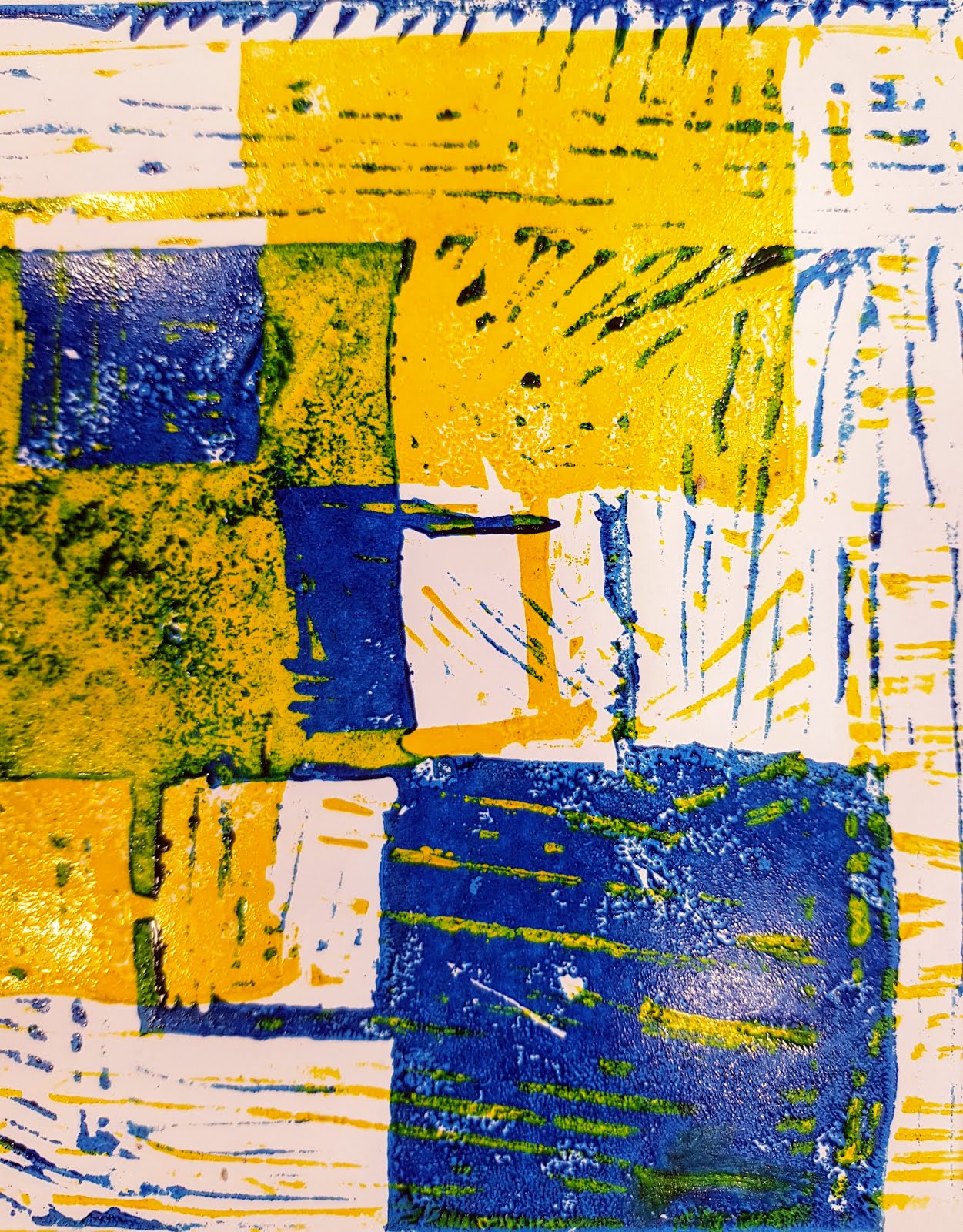
Today I showed you how we can print these two blocks to create colour layers and interesting effects.

The key points we are covering are:

- registration
- transformation
- rotation
- repetition
(these are all mathematical terms too!)


The first point to think about is colour choice. Eventually I want lots of experimentation from you, but to begin with, choose one contrasting colour pair to work from. 

When I showed you printing the first one which was"registration", I blotted the purple before I printed the yellow over top. After experimenting, I am recommending that you DON'T do that, print wet on wet, as it gives another effect to your work that might be more interesting.


This is done with hand printing (not a press). We use a metal spoon to burnish the back of the paper until the print comes through. You need to be patient and careful not to slip. The spoon will heat up because of friction, slow down when that starts to happen. 

Registration:

Rotation:

Transformation:

Repetition:


Everyone needs to be printing by Friday, please don't forget your plates and tools for tomorrow. 


Wednesday, 3 April 2019

LINO CUTTING FROM YOUR ORPHIC THUMBNAIL SKETCHES:


1) Our learning outcome has been:
to develop an understanding of Sonja Terk Delauney, Orphism and colour theory through lino cut printmaking. We should also be cementing our understanding of leading lines and focal points in completing these.

2) Our techniques we have been using have been: Practical knowledge research drawing of terk Delauney's work.Understanding context and Communicating and Interpreting: research information on Terk Delauney on our blogs. Developing Ideas: Thumbnail sketches with colour and annotations, refinement of an idea in colour with annotations. Practical Knowledge: lino cut mark making - two layer plate from one design.

3) The evidence you can provide would be photographic - your work pages to date and your lino plates as they are right now.

4) What worked: completing thumbnail sketches in front of you and explaining leading lines and focal points as I went. I would do this more next time in teaching you. What didn't work: not having a lino print ready to show you before you started the thumbnail sketches, as I think that messed with your heads a bit when I then said take one design and turn it into two plates.

I believe you have a good understanding of the geometry and play with shapes required to achieve the look we are going for with Orphism. Many of you connected really well about making focal points and leading lines a reality in your pieces. i will be working more on colour theory with you next week.


The five paragraphs above were written to this structure. It is also on the Tohatoha section of semester one. USE it as an example and USE it to help guide your writing. 


Wednesday, 20 March 2019

Year 10 Sonja Terk Delaunay

If you missed today:
Practical knowledge and understanding context: how a lino cut works, and some understanding of Delaunay as an artist and person.

We looked really quickly at how a Linocut is made, and looked at Sonja Terk Delaunay's work. She is a painter and designer from the early 20th Century.

We are making a progressive blog post. That means we blog more often and in smaller bits.

Above is what we are looking for in your post. Along with that, can you make sure you consider how you know the artwork is a Sonja Terk Delaunay artwork? What information are you relying on? How can you tell if a site is legitimate?

the last bit of the lesson was using some oil pastels to recreate a small part of a Delaunay piece of work and adding that to your blog post.

Monday, 18 March 2019

Year 10 Blog posts done for Michael Mew

Recently, You were asked to post your work. I am really pleased with those who have as it shows a wonderful range of works:

Alayna .                               Chloe .                            Dylan .                      Jacob .               

Jaime .                                 Jordan .                           Molly .                      Natasha

Nini                                     Presayus                         Riccardo                    Sarah

Shikobi                               Stevie                              Xij


Commitment to your learning, Achievement in completing the piece, Resilience in being brave enough to post about your work and Respect in taking yourselves seriously as artists (self-respect).


Saturday, 16 March 2019

Year 10 Blog posts for Michael Mew

We more or less finished up that piece of work for Michael Mew on Friday. i know a couple of you have a little bit to do to get things complete.

I asked for a summarising blog post. Most of you instinctively ran with this and completed it. Well done.

If you still have to publish or even start (which is fine btw), Make sure you consider our point or what we sometimes call a learning intention; Leading lines focal point, mixed media and unity.

Don't be scared to look at blog posts already made by your classmates and do be brave and get it done. I am not expecting a literary masterpiece, but also dont mind if I get one! What I do appreciate is, if you are brave enough to put yourself out there and post your work proudly.


Monday, 4 March 2019

Year 10 what is our point here?

It's a magazine!

Remember when I asked if you all had read the course outline?

We worked ourselves into groups today and set things up so that you all had a role of kinds.

The magazine is eventually going to use your hand made artwork as graphics and backgrounds, in ways that I would like you to laterally think about how to tell the viewer the meaning, without the benefit of a language that the majority understand (shamefully!).

That means your magazine will be written in te Reo. Your visuals have to speak as loudly as your words.

This is terribly rough. You will create better than this. Each of those groups we developed from the class brainstorm, is responsible for a section each. it may only be 2 pages (a double-page spread) or it might be 4. There is a group for the cover. You will also be responsible for the back of the book.

https://maoridictionary.co.nz/ we only use this as a guide to start understanding how we could use the langauge for titles of sections. Modifiers are important. Ask those students in our class who take te reo as a subject for assistance or seek out help from our two lovely te reo specialists on staff.


Wednesday, 27 February 2019

Year 10 composition - using resources

Using the 10 pages you have pulled out of our magazines, you should have a range of images that could be textural backgrounds or focal points (or a bit of both).

Yesterday we went through these and started cutting things out and refining them. All the way through this, as I did it, I was thinking about potential opportunities with the materials I had.

For instance:


This is the one picture. I just cut the guy out carefully from the background.

As I was doing that, I was thinking about how I could photocopy enlarge the background to use in a piece later on.

            From there, we arranged, recorded (a quick thumbnail sketch in your book) and re-arranged these elements to create compositions with a focal point on a mid-tone piece of paper.

As I did this, again, I was thinking about what my next steps would be. Where paint might go, what I might draw in rather than collage in, what textures might be useful.