Sunday, 20 March 2016

Composition


  • arrangement of elements, subject matter, and stuff in general to make something creative for others to see
MUSIC - Songs are composed. Lyrics are composed, instrumental arrangements are composed, melodies are composed. They are ARRANGED in the best way to capture the audience they are intended for and make you listen again - pop - Intro, verse, chorus, verse, chorus, instrumental, chorus, verse, chorus, chorus, chorus, the end. (This was on the whiteboard last time and I talked to it)

DRAMATIC ARTS - plays/films/t.v is composed. Sets are designed to go with the story, Make up is designed and arranged to go with the characters. characters are developed to portray the main themes of a story and it is all ARRANGED together to keep the viewer watching. 

Same for ART. 

There is very little point in creative works if no one sees them. Make people keep seeing them. Not walk away.

So far we have covered:
  • pattern
  • repetition
  • tension
  • unity


Back to Stylisation

This is a process, but it is not a linear, step-by-step one. There is room for all sorts of creative influence to arrive and be a part of the journey, as your head thinks things out with a pencil.

Last lesson, we looked at this process with an 'exemplar'. That is an example work that shows you a way of thinking something out visually. It is not the only way of making the art work, it is meant to help you get comfortable with trying out a new process by seeing it done by someone else.


This exemplar is the one we referred to on Friday. It is on the google site as well and you should be able to access it whenever you like.

Key things to remember before we start on Monday:

  • This is not the only outcome
  • I have referenced both Art styles studied; Art Nouveau, Kowhaiwhai
  • The original koru come from the veins of the leaves being made prominent
  • You use your leaf form to create your own stylised version
  • One drawing is NOT enough work. It is a start. That is like writing one sentence and calling it an essay.

Your outcomes for the end of Monday's lesson are:

  • A full page of ideas (plural).
  • Excellent drawing skills, you all can, so you may as well show off.
  • Something within that wonderful page that can be used as a print next week. 


Wednesday, 9 March 2016

Next step:

The Rule of Thirds:


Does this look familiar?
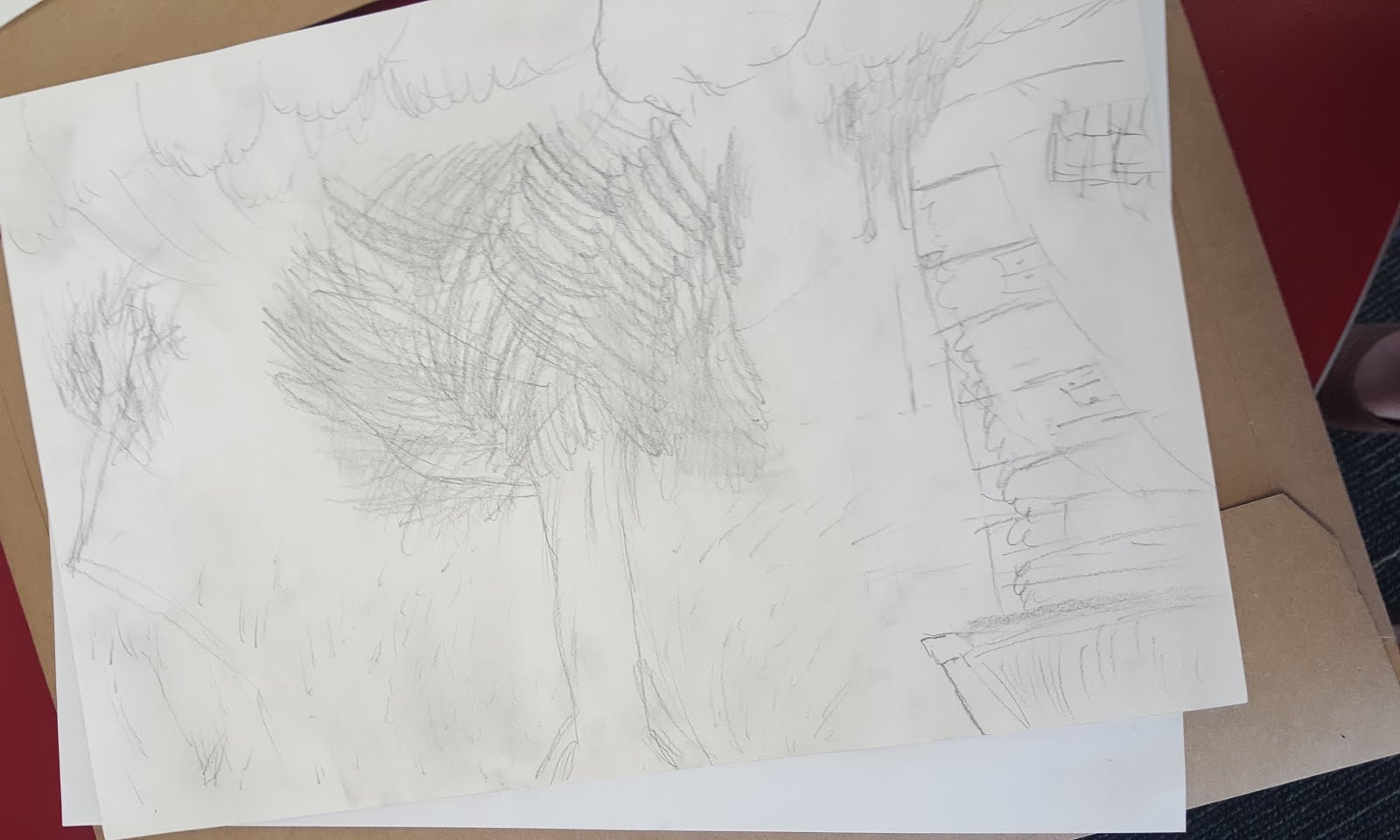
You should have by now, seen the work of Claude Monet, done some investigating of his work and ideas behind impressionism on our google site and done some drawing en plein air of the trees in our school grounds close to our classrooms.

Now we have a whole bunch of photos that we have messed around with in photoshop and illustrator to lose details that stop you from noticing colour and light as much.

The Rule of Thirds - I am going to talk you through this bit:

It is a common way to grid up a photo, painting or drawing. Sometimes Architects and often designers, refer to it in their work.

There are not many real rules in Art and this rule is one that gets used, broken and remade a lot. Our friend, Claude Monet used it. Do we remember him?


Excuse the wonky lines, this was done quickly on www.picmonkey.com those same lines above are over top of this photo to try and demonstrate what the rule of thirds looks like in practice.

Your next step will be how to use these lines to scale up a drawing for painting onto. 


Tuesday, 8 March 2016

7/8 Whanau Class

Hmmm, not sure which blog this lovely class fits into. So I think this post might get repeated. Lovely Xarnie pointed out that I did not have any photos of this class's work up yet. So I am obliging now. This is the start of blocking in some details for an impressionist style painting. Students have actively drawn a lot of drawings of the outside environment focussing on the trees that we have in our school-scape.

We worked "En Plein Air" - 'outside' in French. It was a revolutionary thing that the "Impressionists" did; painting from where they were and what they could see rather than Greek and Roman myths and legends that they had to make up.


These trees were planted when the school was first built. They are older than our students and well-established. They likely all have a wonderful history and if they could talk, a lot of stories to tell!

We worked on using the rule of thirds, dividing the image and then our paper into 3 sections, length-wise and width-wise. There was the tiniest bit of numeracy in this today and everyone coped really well, thinking things through for themselves. Jaleel became the expert at folding the papers into 3's rather than measuring, Nia was amazing in her resilience and independent work ethic, Michelle was possibly the quickest to get onto drawing. 7/8 Wh are lovely, good natured and very, very capable.


Our next step is to start playing with paint and colour theory.

That, and making sure we figure out our Art tikanga in J block...


Monday, 7 March 2016

The Power point from today is on the file cabinet pages for level 2 and level 3 photography


Tuesday, 1 March 2016

Making a Blog for Art

If you missed the last lesson, we are using www.blogger.com to make a blog for Art. All you need is an introduction to what we have done.

- Don't call your blog anything dumb that you will regret in older years, there will always be a trace of it somewhere.
- Always remember that if you are prepared to say something nasty, there are consequences and the LAW covers this, as does our expectations at Hornby High School.
- Keep it classy.

When you are done, email your teacher your blog name and make sure the blog is in fact PUBLIC. Or I cannot read it and it is pointless.


Photography students next steps

Making a proof sheet. You need to upload your photos onto a mac, use photoshop and make a proof or a contact sheet. (We are working on CS6)

You do this by first of all transferring your photos that you took into a folder on the computer. That means you take them OFF the camera. Please delete them from the camera once you have done this.

Once you have that sorted, make sure you know where the folder is and what it is named.

Open photoshop, but do not open any files. click on FILE - then down to Automate, and select contact sheet II.

There is a button called CHOOSE. That is where you need to go, find your folder and select OK.

Photoshop is going to build your proof/contact sheet. Leave it for a few minutes to do this.

Once this is done, flatten each page and save as a JPEG. Ask me or someone who knows how, if you are unsure. Email me your proof sheet and upload it onto your blogs. There is a lot of your figuring this out for yourselves, but once you have done this, you will be sorted and you can teach others in our class.


Sunday, 28 February 2016

What is Research Drawing?

In Art, we often learn by drawing. This is not a 'dumb' skill, it represents the fact that our brains are extremely visual. We respond and react to colour, lighting, textures...

All cultures have a visual look to them. Learning about these before you attempt to be 'original' is important. You cannot know what is to come if you do not know what has been. It is easy to get caught up in this idea that you must be 'new', 'different', not the same as others. But to pretend you have not been influenced by anything that has happened before you came into being an Artist is a little arrogant. It often ends up with people thinking they have produced something original, but in fact it has been done before, probably better!

We learn often by copying, but we develop and grow by using what we know in new contexts, learning ways of making what we learned more original. Being creative.

Research drawing is learning. It is not Art. But that does not mean it is not important. By looking at a style, such as Art Nouveau or Kowhaiwhai, and copying the way they are formed, you are learning how space and form work together, learning the style of the curves used, which are very important, you are developing an affinity with that style of Art.

When you are working on research drawing you must always:
- Make sure you are clearly indicating these works are not your own, they are copies (name the original for instance, of where they came from)
- Don't pretend they are your own designs
- Don't disrespect them visually by making them inappropriate
- Put your best effort into the work, as a mark of respect.

Friday, 26 February 2016

Follow-up on Transcription Progress

So we have to keep remembering the difference between a growth mindset and a fixed mindset, and we are definitely making progress. There is not one student in this class who is not coping. So proud.

Thursday, 25 February 2016

8GB - Pretty nice class :-)

  Students in all of the year 7 and 8 classes had to sit outside and draw "en plein air' (in fresh air). They had to draw quickly, with energy and what they saw, not what they knew. This is challenging! These examples are from 8GB. 7/8WH, 8MT and 7BK also worked really hard on this task with a great selection of work coming through. Over the course of the week I will post some examples from all of the classes.

Impressionism - Revolutionaries

Impressionism is from the19th-century. It is an art movement. This means there were a group of Artists who had similar ideas and became known for a particular style and/or way of thinking in their work.

It started during the 1870s and 1880s. Remember what was invented just before this time? We discussed it in class.

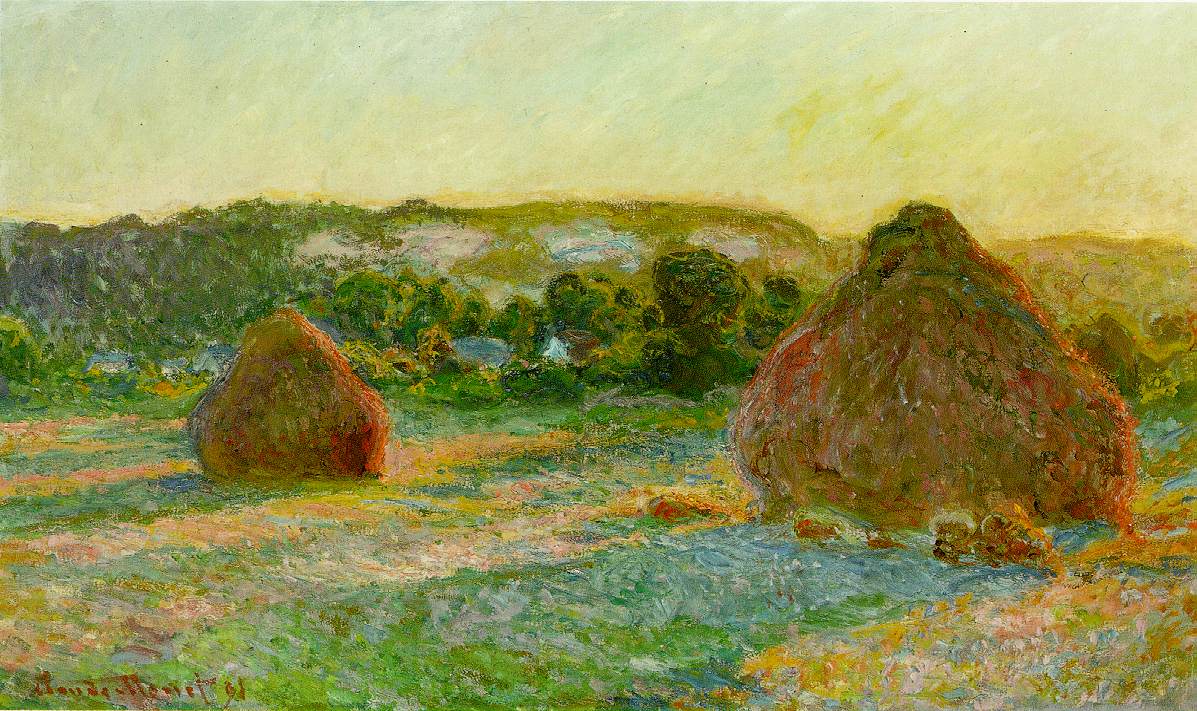
Impressionist paintings all have really visible brush strokes, they often show light and its changing qualities (think about the Haystacks by Claude Monet I keep showing you all and how you can see when it is a different time of the day), ordinary subject matter, trying to show movement in the works and using new angles in painting that had not been used before.


Wheatstacks_(End_of_Summer),_1890-91_(190_Kb);_Oil_on_canvas,_60_x_100_cm_(23_5-8_x_39_3-8_in),_The_Art_Institute_of_Chicago.jpg
Claude_Monet._Haystack._End_of_the_Summer._Morning._1891._Oil_on_canvas._Louvre,_Paris,_France.jpg
Claude Monet, 1890-91 Oil on canvas, 60 cm × 100 cm (23 5⁄8 in × 39 3⁄8 in). Location currently: Art Institute of Chicago “Wheatstacks; end of summer”
Claude Monet, 1890-91 Oil on canvas, 60.5 × 100.8 cm (23.8 × 39.7 in). Location currently:Louvre, Paris, France “Wheatstacks; end of summer” (again, he did a lot of these).


Remember your HOMEWORK: notice the sunset. Pick an object to watch outside your bedroom window and notice how the light/colour/look changes as the light fades.

The Académie des Beaux-Arts controlled everything about French art. The Salon (a panel of experts) selected the works considered suitable for the Académie each time they had an exhibition.

After Emperor Napoleon III (France's leader) saw the rejected works of 1863, he decided that people could look for themselves at how useless the Artists were who had been rejected. He wanted the people to come along and laugh at them.

This was called the Salon des Refusés (Salon of the Refused). This actually backfired. People did come, more than usually attended the actual Salon, and quite a few liked what they saw. It was not the same old boring stuff they were used to seeing and showed things that were happening in people's everyday lives at the time.

In December 1873, Monet, Renoir, Pissarro, Sisley, Cézanne, Berthe Morisot, Edgar Degas and several other artists founded the Société Anonyme Coopérative des Artistes Peintres, Sculpteurs, Graveurs ("Cooperative and Anonymous Association of Painters, Sculptors, and Engravers") to exhibit their artworks independently.[9] ( this bit is from https://en.wikipedia.org/wiki/Impressionism and those links will take you to those Artist’s wikipedia pages)

Interviews 2016

Quaid


Real men don't cry. Why? Where did the stereotype start? Greek culture? The base of western civilisation


Marion McGuire - printmaker, find examples of her work that are specifically greek/maori mythology. Blog 3 of these.

Talk about them and try and establish a relationship between them and your ideas so far. This is a starting point.


Kgyd
Ana’s painting from last year is influential to him
Likes the flow from one image to another - as a way of linking multiple pieces of work
Bullying, trees, sky, people, poor people, defining love. Why are there no references to samoan standards of beauty?


  • Rene Magritte
  • Salvador Dali


Find examples of their work that you like. make sure you put the title and date of their work. post them on your blog and say why you have chosen these images as starting points


Draw out some ideas as thumbnail sketches, next week we will discuss these in class and what to do next

Interviews with Painters February 2016 - folio direction. 2 classes done at this point, 2 to come.

Brianna
was meant to read the comment on her blog and act… is now doing so

Shavaughn

Cartoon illustrations of girls, tvs and cameras, being controlled, hypnosis, tv with the swirls, being drawn in, a girl being controlled having to make a choice, as to which path to take, feelin glike she has to fit in, not sure what to do.
  • strong narrative
- references to pop art
- 1950’s iconography
- Miss van - graffiti cartoon figures

  • appropriation
  • graphic novel approach

Maddie
Hype around the earthquakes, abandonment in the red zone. Is the media hyping things up
  • Understand how the media can blow things out of proportion
  • Antonio hall near Riccarton - there are tours available. check it out.
  • Find an example online of media making more of a story than was there, try and relate it back to red zoned housing and earthquakes in chch.
  • Can you get out to the east with DAD to take photos of an abandoned property? Even spaces where houses used to be and are no longer?
  • Mrs Clemence can go out NEXT weekend too.

-Archealogical dig element to this, looking at ruins?

Saturday, 20 February 2016

Clarifying Stylisation - Friday Period 2 19th February

So last lesson, we talked about stylisation and what that could mean in music as a way of trying to illustrate it.

From now, we need to see it from a visual perspective.

Below are some visuals that show stylisation happening to a visual form:


This is an example of stylisation of a rooster by a graphic designer called Maria Muzaffar. She is a graphic designer and was working towards developing a logo for a company.

With Kowhaiwhai, these forms came from a plant form.


Your task:

From the Pinterest page or the paper resources we have, make a page of RESEARCH drawings of Kowhaiwhai.

Your page should be a good typical workbook page, as we have already discussed.